





Every muscle in a horse’s body depends on oxygen. Yet compared with fitness, nutrition, joints, and recovery, the respiratory system receives relatively little attention.
In this conversation, Dr. Jim Chiapetta takes us inside the horse’s airways and explains what happens when a horse begins to work harder. He also explains how supporting a small area of soft tissue above the nostrils can reduce the amount of effort required to breathe.
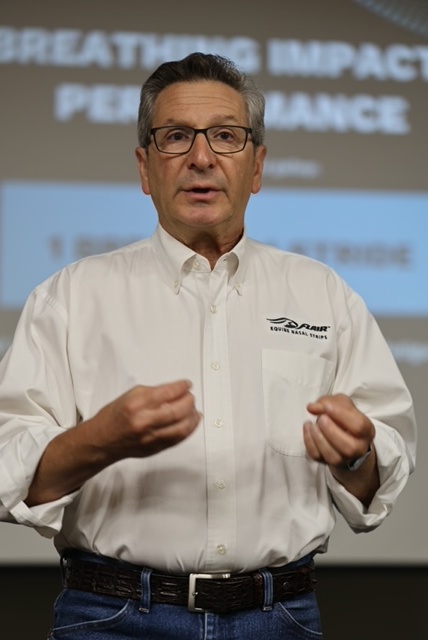
Jim is an equine veterinarian, attorney, inventor, and co-inventor of FLAIR Nasal Strips. He is also the founder of Achieve Equine, a company that develops products designed to support equine health and athletic performance.
This episode of The HorseGrooms Podcast is sponsored by Achieve Equine.
Horses Can Only Breathe Through Their Nose
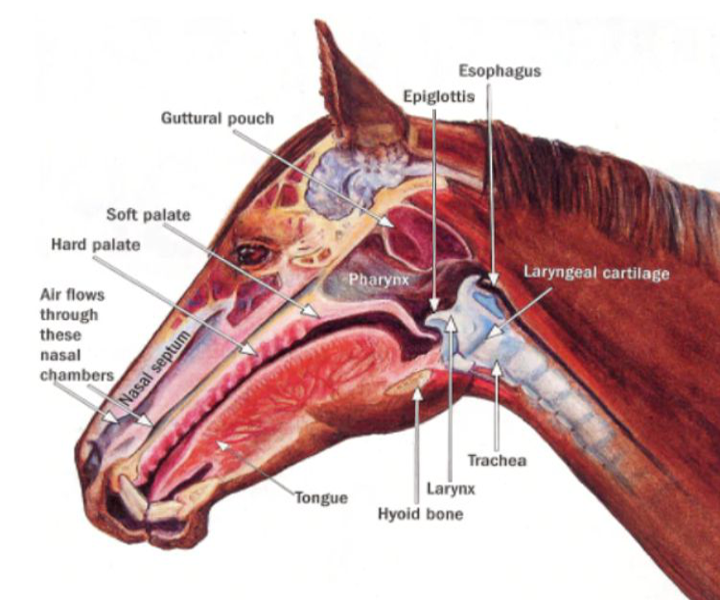
Unlike people, horses cannot simply open their mouths and breathe through them when they need more air. Horses are obligate nasal breathers, which means that the air they breathe must enter through the nose.
A horse has a long soft palate that separates the mouth from the nasal airway. This arrangement helps protect the airway while the horse is eating. It may have been especially valuable during the horse’s evolution as a prey animal. A horse could graze with its head down and then quickly run away without pulling food into its airway.
However, this anatomy also means that during exercise, all the air the horse needs must travel through the nasal passages.
That is a major task. During very intense exercise, a horse may move approximately 1,500 liters of air per minute. Jim compares that amount to around six bathtubs or nine large 55-gallon barrels filled with air.
Every bit of that air must pass through the horse’s nose.
The Respiratory System Is an Athletic System
Horse people spend a great deal of time thinking about muscles, joints, fitness, nutrition, and recovery. The respiratory system often receives less attention unless a horse coughs, makes a noise, or appears to have trouble breathing.
Jim believes we should also view the respiratory system as an athletic system.
The horse’s muscles need oxygen to produce the energy required for movement. The heart transports oxygen-rich blood through the body, but that oxygen first has to enter through the respiratory system.
“The entire body only works because of oxygen, and the only way oxygen gets there is through the respiratory system,” Jim explained.
As a horse begins working harder, it must move more air through its airways. Jim compares the respiratory system to a tube that begins at the nostrils and ends in the lungs. When the horse exercises, it is almost like a large vacuum cleaner powering up and pulling more air through that tube.
The harder the horse works, the harder the respiratory system must work too.
Why the Horse’s Airways Become Narrower
Much of the horse’s airway is made of soft, flexible tissue. That flexibility is necessary because the airway must expand as air moves in and out.
However, soft tissue can also be pulled inward when the horse inhales forcefully.
Imagine drinking through a soft straw. As you suck harder, the walls of the straw begin to collapse inward. Something similar can happen within the horse’s nasal passages during intense exercise.
The nostrils themselves are very good at opening. The area that needs support is slightly higher up, behind the nostrils. This is the narrowest part of the airway and the place where soft tissue can be pulled inward as the horse tries to inhale large amounts of air.
How FLAIR Nasal Strips Work
A FLAIR Nasal Strip does not pull the horse’s nostrils open. Instead, it supports the soft tissue above and behind the nostrils.
This is one of the biggest misunderstandings about how the Strips work. When looking at a Strip from the outside, it may be difficult to understand how it could change the horse’s breathing. It does not lift the nose or visibly pull the nostrils apart.
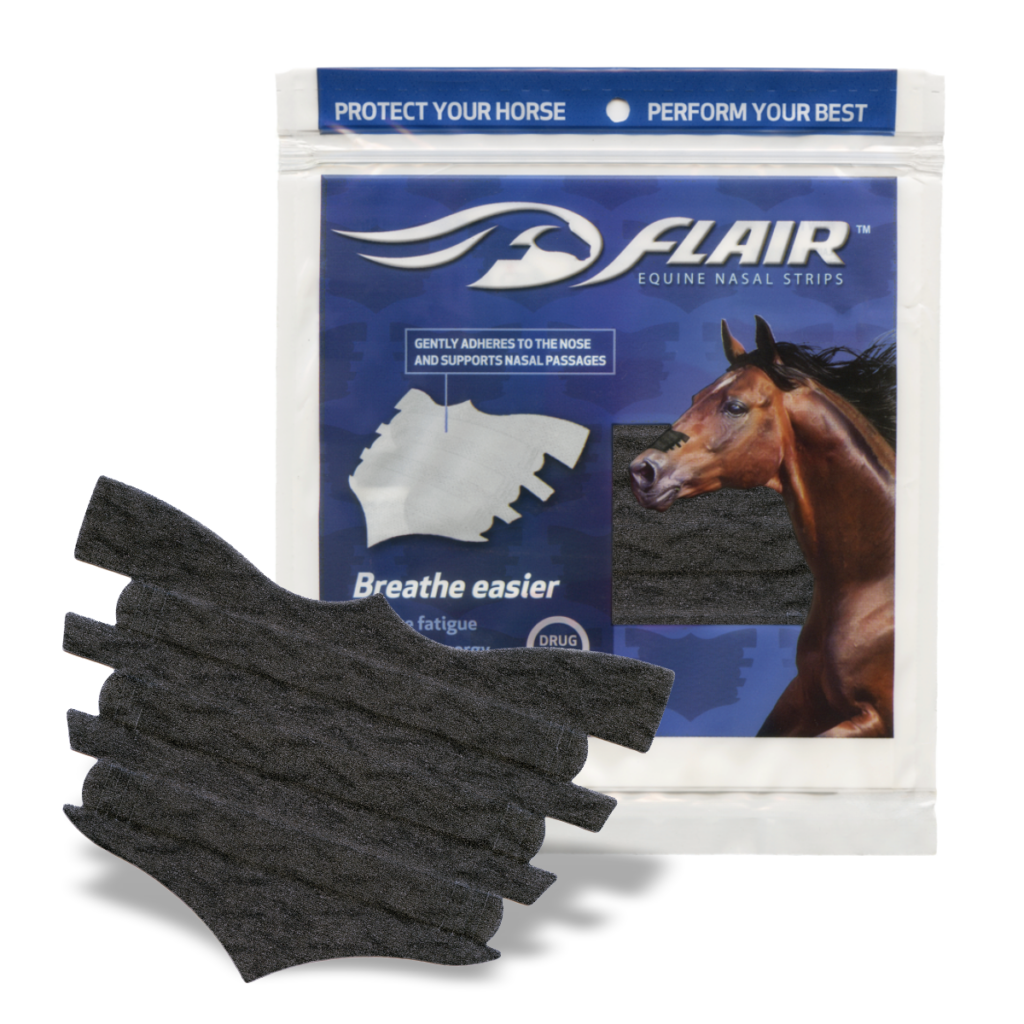
Its purpose is to help prevent the soft tissue from being drawn inward during inhalation.
By supporting this area, the Strip reduces resistance within the nasal airway. The horse can move the same amount of air while using less effort.
This distinction is important. FLAIR Nasal Strips do not cause the horse to take in more oxygen. They help the horse take in the oxygen it needs with less work.
The energy the horse saves on breathing may be available for the muscles involved in movement. This has been shown to be the case in humans. While equine scientists also believe this to be the case in horses, more research is needed to confirm that it is the case in horses too.
Jim referred to research from two different studies that showed that horses wearing the Strips used approximately 5-6 percent less energy for breathing during exercise.
Respiratory Load: The Work Required to Breathe
Jim uses the term “respiratory load” to describe how much work the respiratory system must perform during exercise. Research has shown that FLAIR Strips do reduce respiratory load.

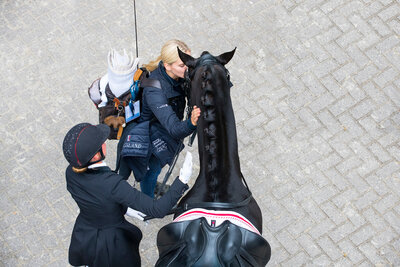
FLAIR® Strip on his horses, like on his horse Chatolinue PS at the WEG in Aachen.
As exercise becomes harder, the horse needs to move more air. This increases the demand on the respiratory system. Every breath requires energy, and the harder it becomes to move air through the airway, the more energy breathing requires.
Reducing resistance does not change the amount of oxygen in the air. Instead, it reduces the work required to bring that air into the body.
This is why Jim recommends considering the horse’s level of exertion rather than focusing solely on its discipline or competition level. For example, a horse that normally does two short, low-impact trail rides during the week may find an hour-long weekend ride with plenty of trotting and cantering very demanding. The same ride might not be especially intensive for a fit, high-level eventing horse or show jumper.
A lower-level horse may work extremely hard because it is less fit or because it is being asked to do more than usual. A well-conditioned horse doing light work is likely experiencing much less respiratory load.
The horse does not know whether it is training or competing. Its body only recognizes how hard it is working.
Correct Placement Matters
For a FLAIR Nasal Strip to support the right area, it must be positioned correctly.
Jim recommends placing the lower edge of the Strip approximately two finger widths above the horse’s nostrils. This positions the Strip over the soft tissue that can be pulled inward during hard breathing. Listen to the podcast to know what to feel for at the correct location.
The nose should also be cleaned before application. According to Jim, failing to clean the nose is the most common application mistake.
Noseband placement deserves attention too. A noseband positioned too low may compress the same soft tissue the horse needs to move air through. A correctly positioned noseband should not stop a properly applied FLAIR Nasal Strip from working.


What Scientific Studies Have Found
FLAIR Nasal Strips have been examined in scientific studies conducted by several universities and equine research organizations.
Jim explained that researchers have measured what is known as peak inspiratory pressure. This is the strong negative pressure, or suction force, created when a horse inhales forcefully.
Studies found that this pressure was lower when horses wore FLAIR Nasal Strips. In simple terms, the horses did not have to pull as hard to bring air into their lungs.
Research has also studied the Strips in relation to airway resistance, the energy required for breathing, recovery after exercise, and exercise-induced pulmonary hemorrhage.
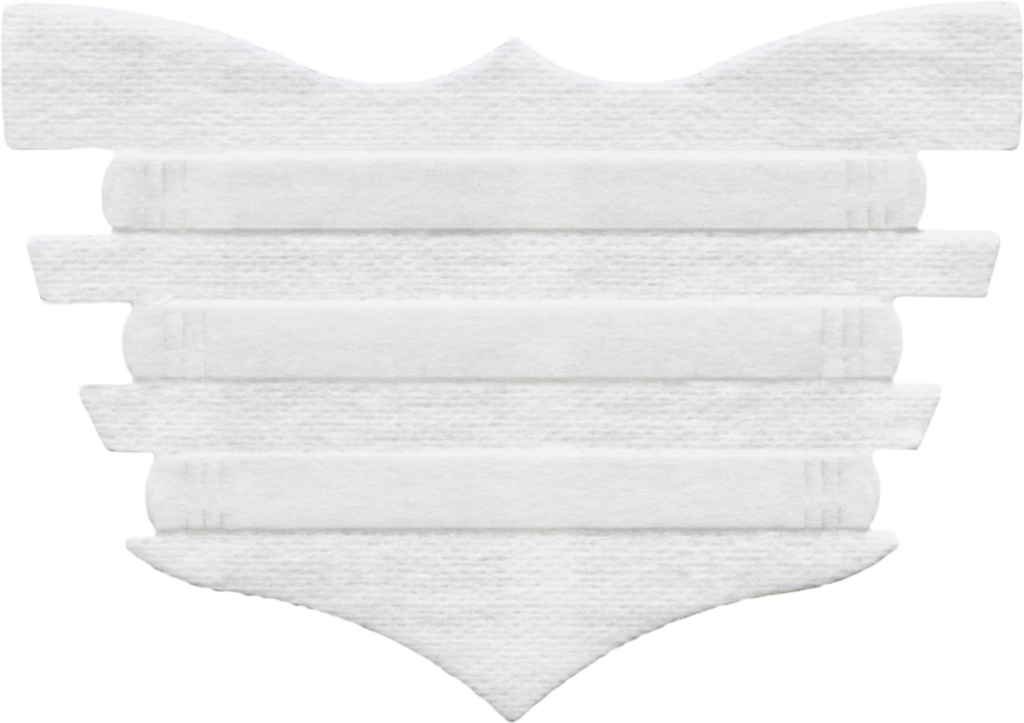
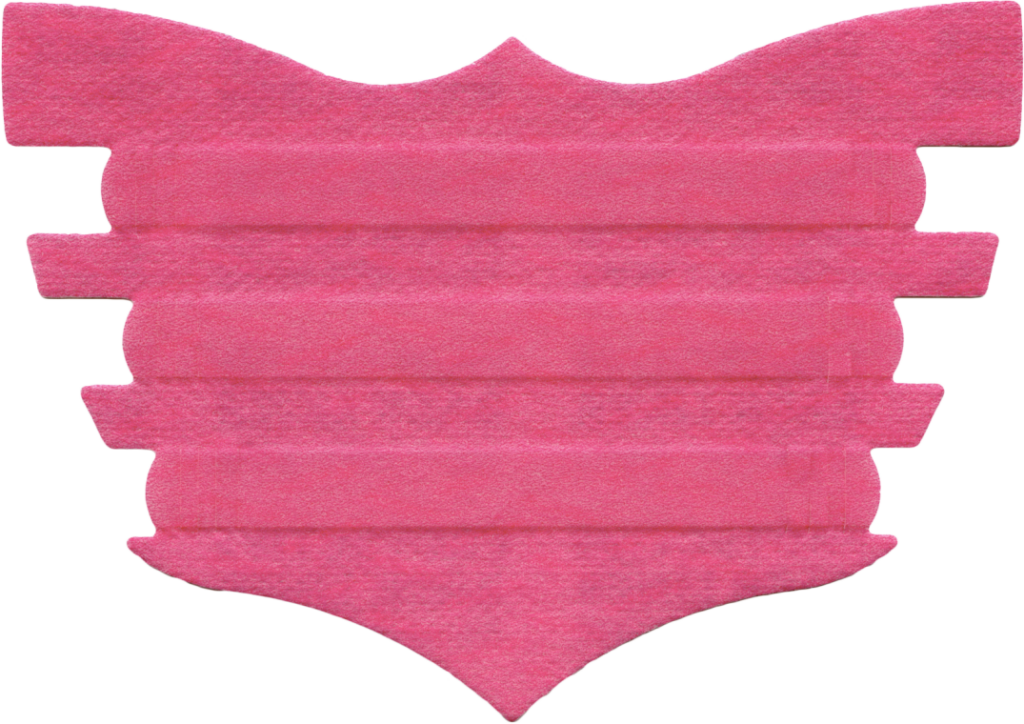
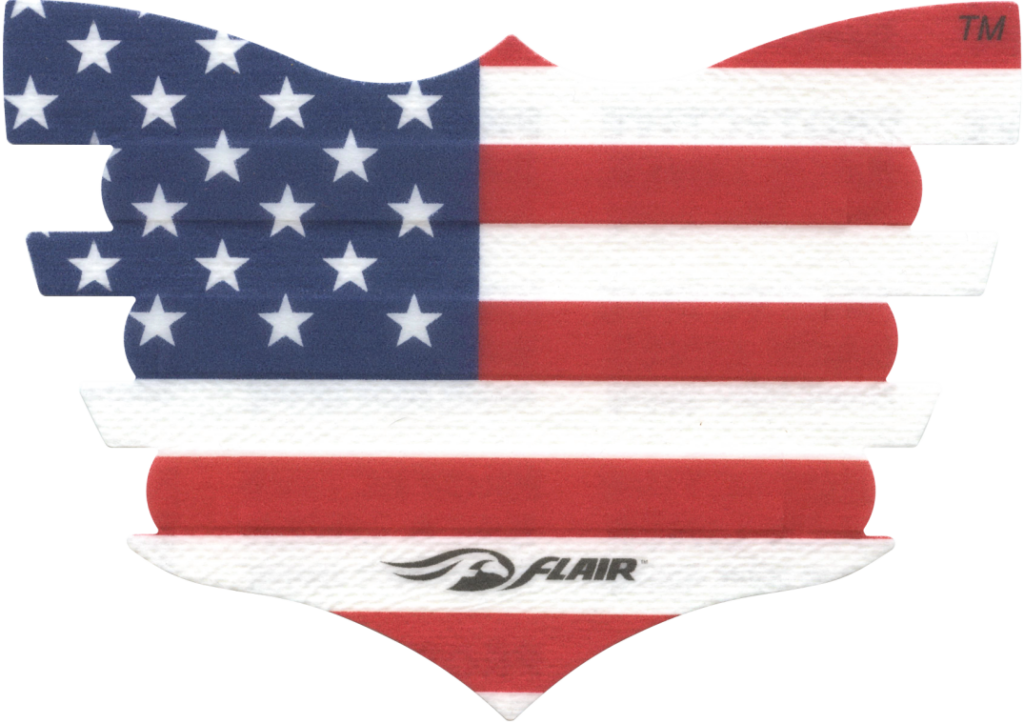
Summaries of the clinical studies are available through the FLAIR Nasal Strips website, where you can also purchase the Strips. Listeners of the HorseGrooms Podcast can get 20% off their purchase with code HORSEGROOM20.
“Nosebleeds” and Exercise-Induced Pulmonary Hemorrhage
Horse people may be more familiar with the term “nosebleed” than exercise-induced pulmonary hemorrhage. However, “nosebleed” is often not an accurate description of what is happening.
Does The Blood Come From The Nose Or The Lungs?
A true nosebleed suggests that the blood comes from somewhere inside the horse’s nose. With exercise-induced pulmonary hemorrhage, usually shortened to EIPH, the blood comes from the lungs and enters the horse’s airways during or after exercise. In a more serious episode, that blood may travel through the airways and become visible at the nostrils.
This means that when blood appears at a horse’s nostrils following hard exercise, it may not be coming from the nose at all. It may have traveled from deep inside the lungs.
Visible blood can indicate a more severe episode of EIPH. However, the absence of blood at the nostrils does not mean that no bleeding has occurred. Much smaller amounts of blood may remain deep in the lungs and can only be detected through veterinary examination.
Blood Pressure Vs Pulling Pressure
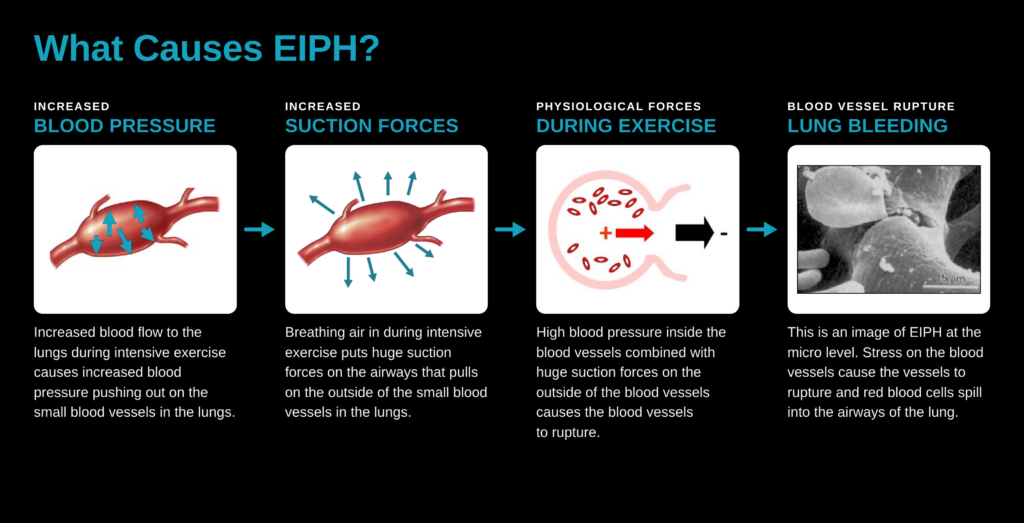
Jim explained that during intense exercise, blood pressure inside the small blood vessels of the lungs rises sharply. At the same time, the horse creates a strong pulling pressure as it draws air into the lungs.
The thin membrane between the airways and the blood vessels is extremely efficient. It allows oxygen to enter the blood and carbon dioxide to leave it. However, this membrane is also delicate.
Jim described the forces on it as a push from one side and a pull from the other. The high blood pressure pushes outward while the force of inhalation pulls from the airway side. Under enough pressure, small blood vessels can break and allow blood into the airways. Nothing has been shown to stop EIPH. FLAIR Nasal Strips have been shown to significantly reduce EIPH. By reducing airway resistance, they reduce the pulling pressure created during inhalation. Studies have shown this is a major path for reducing the severity of EIPH.
Surface conditions, speed, fitness, age, and the physical forces placed on the horse may also contribute to EIPH. Jim discussed how landing after a jump can create additional pressure as the contents of the abdomen move forward toward the lungs.
The goal is to understand these forces and reduce unnecessary stress on the horse whenever possible.
What Grooms Should Watch For
Grooms are often the first people to notice when something changes in a horse.
Jim said that unusually fast breathing while a horse is resting should never be ignored. Respiratory noises also deserve attention.
Other changes, such as coughing, a longer-than-normal recovery, poor performance, or visible blood at the nostrils, may require veterinary investigation. A FLAIR Strip is a supportive device. It does not replace diagnosing or treating an underlying respiratory problem.
Because grooms see, touch, and care for their horses every day, they are in an important position to recognize what is normal for each horse and when something is different. Jim expressed his appreciation for grooms who ask questions, challenge ideas, and pay close attention to the horses in their care. “Somebody has to be watching out for the welfare of the horse,” he said.
Designing a Boot That Allows Air to Move
The final part of the conversation moved from breathing to another subject involving airflow: tendon boots.
Jim and the Achieve Equine team are developing a new boot intended to protect the horse’s leg while allowing more air to circulate around it.
According to Jim, the main purpose of a boot is to protect a horse’s leg from impact, either from another leg or from an obstacle. He said there is not enough evidence to support claims that ordinary boots can physically support the tendons or prevent the fetlock from dropping.
At the same time, covering the leg can create another problem: trapped heat and moisture. Tendons naturally generate heat during exercise. As the fetlock lowers and the tendons stretch, they store and release energy in a spring-like action that helps move the horse forward. Some of that energy becomes heat.
Unlike muscles, tendons have relatively little blood flow to help carry heat away. Air moving around the leg and the evaporation of sweat both help cool the area. A conventional boot or bandage can interfere with this process by holding warm, damp air against the leg.
Achieve Equine’s new boot is designed to touch the leg only in specific places. This leaves space for air to move through the boot. With every stride, the movement of the leg is intended to push warm, moist air out and allow fresher air to enter.
Why Feedback From Grooms Matters
Last Wellington, FL season, Jim brought an early version of the boot to Tacos, Talks & Connections, one of the HorseGrooms MeetUps. He wanted feedback from the people who would actually use the boot. He asked the attending grooms to handle the boot, put it on, take it off, and share their honest opinions.

The grooms considered practical questions that engineers may not immediately recognize. Is the boot easy to apply? Could it rub? Will it slip? Are the tabs practical? Is the padding placed correctly?
Their feedback contributed to optimizing the design. Jim’s engineers may understand why the boot should work, but he believes the people who use this equipment every day must also explain whether it works in practice.
Achieve Equine is now working on a later version of the boot and preparing for more testing, including testing in hot conditions where controlling heat and moisture may be especially important.
Listen to the Full Conversation
This episode goes much deeper into the horse’s respiratory system, the research behind FLAIR Nasal Strips, EIPH, respiratory load, and the development of Achieve Equine’s new tendon boot.
Listen to the full conversation with Dr. Jim Chiapetta on The HorseGrooms Podcast right here on our website, on the Equus Radio Network, or through your favorite podcast platform.
If you find the episode helpful, please leave a review of The HorseGrooms Podcast on your favorite podcast channel. Reviews help more horse people discover these practical and educational conversations.
Learn More About Jim Chiapetta, FLAIR Nasal Strips, and Achieve Equine
Learn more about FLAIR Nasal Strips and the research behind them at flairstrips.com.
You can also follow Dr. Jim Chiapetta on LinkedIn, where he shares educational information about equine breathing, respiratory health, and product development.
Don’t forget to use the one-time discount code HORSEGROOM20 for 20% off when you purchase FLAIR Strips straight from the FLAIR Strips website.
This Episode of The HorseGrooms Podcast Is Presented by Horcery
The Horcery AI-Powered Stall Monitor
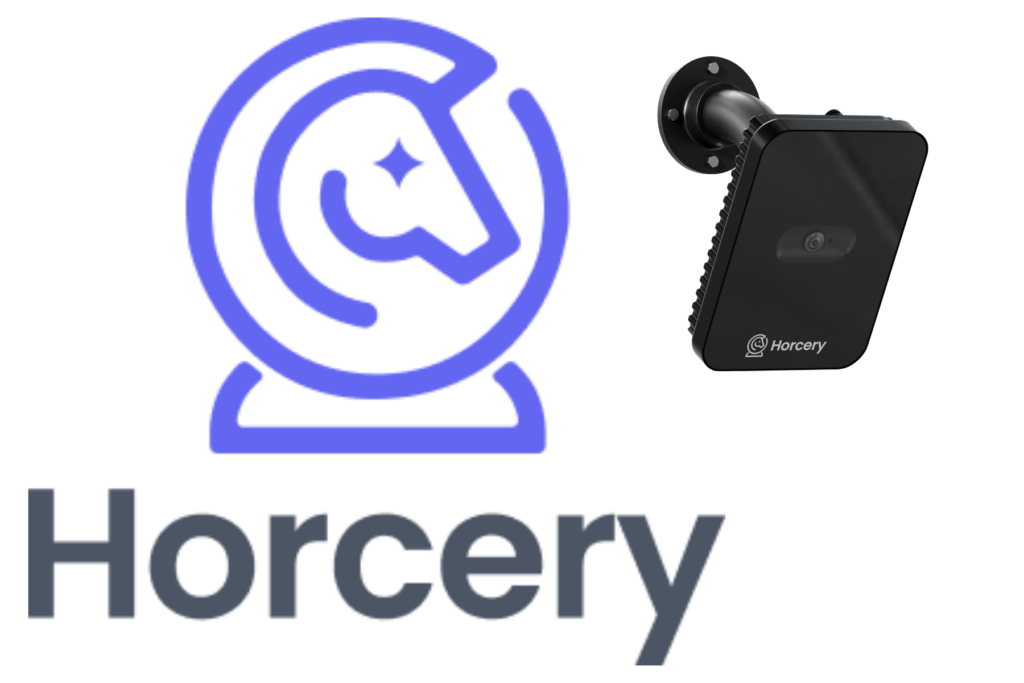
The Horcery AI-powered Stall Monitor helps horse owners, grooms, and barn managers stay connected to their horses around the clock. It monitors activity inside the stall and sends intelligent alerts when unusual behavior occurs. It is an extra set of eyes that can provide valuable peace of mind when you are away from the barn.
HorseGrooms readers and listeners receive 5% off a Horcery Stall Monitor with the discount code HORSEGROOMS05.
Read this article or visit horcery.com to learn more about this helpful tool for the barn.
More HorseGrooms Resources
Looking for more practical horse care education?
Subscribe to the HorseGrooms monthly Newsletter to not miss anything, explore the HorseGrooms articles, educational webinars, HorseGrooms Community, and HorseGrooms Insiders, where experienced horse care professionals from around the world share the knowledge that helps horses thrive.
Become a HorseGrooms Insider to receive access to exclusive webinars, live Q&A sessions with industry experts, educational resources, mentorship, discounts, perks, and more. Everything is free when you are an Insider.
Use the discount code HGPODCAST to receive 10% off your HorseGrooms Insiders membership.

HorseGrooms is a platform of resources, education, and support for grooms by grooms. This is an online community, hub of resources, and spotlight of industry highlights born out of love for the horse and love for the sport. But our mission goes beyond simply providing resources and creating content.
Our goal is to create a space to keep horsemanship alive; for grooms to support and educate each other; and to help advance the craft of grooming. HorseGrooms is dedicated to ambitious grooms everywhere.